Services
- Garage Floor – Metallic Epoxy
- Garage Coating – Heavy Flake
- Basement Coating – Epoxy Heavy Flake
- Basement Coating – Metallic Epoxy
- Concrete Polishing
- Concrete Prepping
- Garage / basement Coating – Stained
- Hardwood Floor – Refinishing
- Hardwood Floor – Screen & Recoat
- Hardwood Floor – Wax Removal
- Hardwood Floor – Stain/Color Correction
A three-coat epoxy system
(Epoxy Moisture Barrier Basecoat)
(Heavy Flake Coat)
(Polyaspartic Topcoat)
is a durable, long-lasting, and low-maintenance coating that can be used in both interior and exterior applications. Polyaspartic coatings are made from a combination of ester and other materials that create an aliphatic and polyurea sealer. They are often used in garages, basements, and commercial and industrial spaces.
Here are some benefits of a three-coat epoxy system with polyaspartic:
Quick curing
Polyaspartic coatings cure quickly, so adding an extra coat doesn’t significantly increase the time it takes to complete the job. The coating can be applied in multiple layers with a brush or roller, and it’s usually tack-free in 35–45 minutes.
Durable
Polyaspartic coatings are more durable than epoxy and can protect against damage from wear and tear, water, stains, chipping, and more. Producing a highly functional and aesthetically pleasing floor finishes, epoxy flake flooring systems combine vinyl flakes with epoxy and polyaspartic coatings. Designed to suit any environment, epoxy flake floor coatings provide a customized finish.
The beautiful appearance of a garage floor coating is what convinces most homeowners to decide to improve their garage floor and use our Floor Coating Services. Garage floor coatings are manufactured in a number of great looking solid colors, and you can add decorative flakes to give it more traction and a classier appearance. Not only that, garage floor coatings extend the life of your garage floor. Most are made of a high-grade epoxy which repels water, oil, and other materials, resisting the contaminants that eat away at your garage floor and eventually cause it to fail. Not to mention they make clean-up a lot easier. There’s a reason that auto shops are one of the prime commercial customers when it comes to this innovative garage flooring solution.
Metallic epoxy is a type of epoxy that contains metallic pigments. As the epoxy and metals are mixed together and cure, the resulting metallic powder blends to create a lava-like flow or pearlescent design—creating a floor with an exotic and eye-catching appearance. The beautiful appearance of a garage floor coating is what convinces most homeowners to decide to improve their garage floor and use our Floor Coating Services. Garage floor coatings are manufactured in a number of great looking solid colors, and you can add decorative flakes to give it more traction and a classier appearance. Not only that, garage floor coatings extend the life of your garage floor. Most are made of a high-grade epoxy which repels water, oil, and other materials, resisting the contaminants that eat away at your garage floor and eventually cause it to fail. Not to mention they make clean-up a lot easier. There’s a reason that auto shops are one of the prime commercial customers when it comes to this innovative garage flooring solution. |
|
These outstanding applications for polyaspartic and polyurea finishes provide superior durability as well as chemical, UV, and solvent resistance. Overall benefits of metallic floor coatings include beauty, sustainability, resilience, and versatility including the following: Resistance to chemicals and stains. Epoxy is resistant to bleach, oil, gasoline, cleansers, transmission fluid and so much more. Additionally, epoxy floor is heat and water-resistant. In fact, epoxy flooring offers excellent fire protection because certain pigments used in the coating actually expand when exposed to heat.
Polished concrete is the ultimate no-wax flooring material. With the proper floor grinding equipment and experience, concrete polishing contractors can grind concrete surfaces, whether new or old, to a high-gloss finish. Factor in the superior durability and performance of concrete, and it’s no wonder why retail, commercial warehouse and office facilities, and even homeowners are catching on to the appeal of these smooth, high-luster floors.
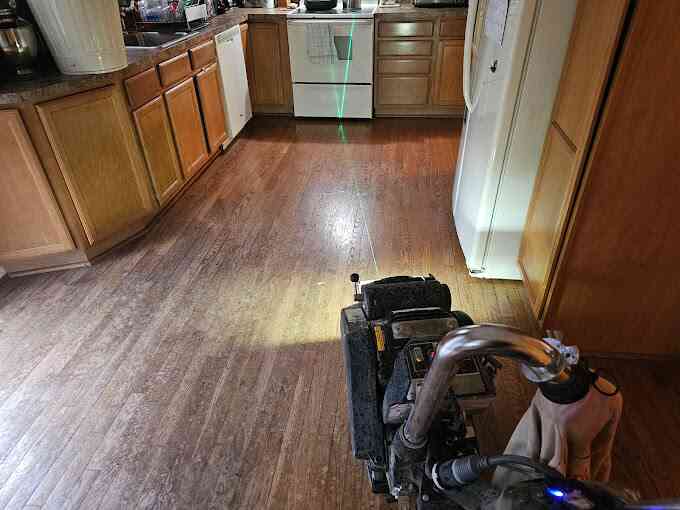
Refinishing involves sanding down the floor to remove the top layer of the finish, then staining and sealing the wood. This is a more intensive process that will take several days to complete. Refinishing hardwood floors is a process in which the old finish on your floors is stripped away, then a new finish is applied to the wood. The good thing about refinishing hardwood floors is that it can usually be done without removing the old boards, which can be time-consuming and expensive. While refinishing hardwood floors can be an excellent option for bringing old wood back to life, it’s a process that doesn’t happen overnight. It will likely take a few days to complete, and you’ll need to stay out of the room until the process is finished. But once it is, your hardwood floors will look brand new!
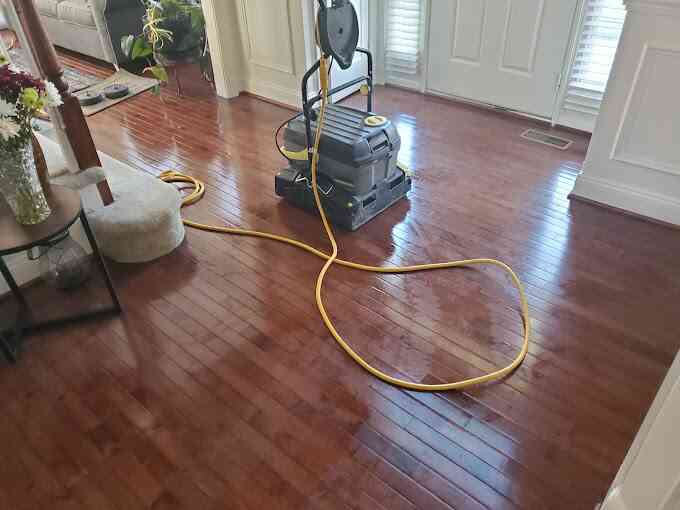
Screening both smooths the floors a bit, and the abrasive action allows the polyurethane to adhere to the surface better. The screen and recoat process can restore the glow of the floors and give them a refreshed look. A hardwood floor screening takes no sanding. In fact, we do not touch the wood itself. Instead, we deep clean the floors, then “screen” them with an abrasive pad, and then apply a fresh coat of finish. Many historic homes and structures maintain their hardwood’s sheen with yearly Screening and Recoating. And when you first contact us we will evaluate your floors to decide whether a refinish or a clean & buff would suit them best.
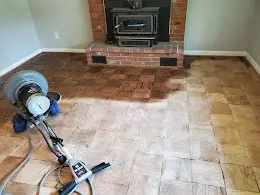
Despite regular cleaning, wax can collect fine dirt and become dull, dirty and dark over time. Reapplying wax rejuvenates the floor, but eventually creates a hazy build-up. The wax needs to be removed using a wood floor wax remover and reapplied to make the floor look new again. We apply a product designed to remove natural or synthetic floor polishes or waxes through breakdown or by dissolving or emulsifying the polish or wax.